Mercore Advisory - Executive Pattern 04
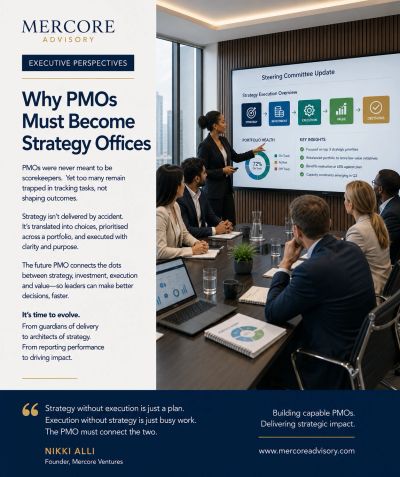
Why PMOs Must Become Strategy Offices
For years, many PMOs have been judged by the quality of their governance, reporting and delivery controls.
- Are programmes on track?
- Are risks being managed?
- Are milestones being met?
- Is the portfolio within budget?
All important questions.
But they are no longer enough.
The more important question is:
Are we investing in the right things—and are those investments actually delivering the strategy?
That is where I believe the mandate of the PMO has to change.
From reporting delivery to enabling strategy
A PMO can produce excellent dashboards and still have very little influence over whether an organisation achieves its strategic objectives.
I have seen PMOs with sophisticated reporting, disciplined governance and well-run steering committees that could tell leadership precisely what was happening across the portfolio.
What they couldn't always answer was why the organisation was still investing in certain initiatives, whether those initiatives remained strategically relevant, or whether the expected value was actually being realised.
That is the difference between a PMO that monitors execution and one that helps shape it.
The modern PMO should sit much closer to the strategy of the organisation.
It should understand where the business is going, translate strategic priorities into executable portfolios and give leadership the intelligence to make choices about investment, capacity, risk and value.
The PMO should help answer different questions
Instead of primarily asking:
Are our projects on time and on budget?
We should increasingly be asking:
- Which investments matter most to our strategy?
- Where are we committing scarce resources without sufficient return?
- Which initiatives should be accelerated, challenged, reshaped—or stopped?
- Are the benefits promised in the business case actually materialising?
- What has changed since we approved this investment?
Those are strategy questions.
And someone needs to maintain the connection between those decisions and execution.
That is where a strategically positioned PMO can become invaluable.
AI makes the shift even more important
AI will accelerate this evolution.
Much of the administrative work traditionally associated with PMOs—consolidating status information, producing reports, identifying patterns, analysing dependencies and supporting forecasting—is increasingly capable of being automated or augmented.
That should not threaten the PMO.
It should liberate it.
The value of the PMO should increasingly come from what technology cannot simply automate: judgement, challenge, prioritisation, organisational context and executive decision support.
Recent thinking on AI-powered transformation offices similarly points towards AI handling more routine analysis while human teams concentrate on complex challenges, governance and outcomes.
The question therefore isn't whether AI will change the PMO.
It already is.
The question is what the PMO does with the capacity AI creates.
Using AI simply to produce the same status report faster is not transformation.
Using better intelligence to identify emerging risks, challenge investment assumptions, anticipate capacity constraints and improve executive decisions is.
From PMO to Strategy Office
I am not suggesting every organisation needs to rename its PMO.
The name matters far less than the mandate.
Whether it is called an Enterprise PMO, Transformation Office, Strategy Execution Office or something else, its relevance will increasingly depend on its ability to connect five things:
Strategy → Investment → Execution → Value → Decisions
When those elements are disconnected, organisations can execute programmes successfully while still failing to deliver their strategy.
When they are connected, the PMO becomes much more than a governance function.
It becomes part of the organisation's strategic management capability.
The future PMO shouldn't simply tell executives whether the portfolio is green, amber or red.
It should help them decide whether they have the right portfolio in the first place.
And that, for me, is the shift from Project Management Office to Strategy Office.
About the Author
Nikki Alli is Founder of Mercore Advisory and an Executive Transformation Leader with over 25 years' experience helping boards and executive leadership teams strengthen strategy execution, governance and AI-enabled business transformation across the Middle East, Africa and Europe.
About Mercore Advisory
Mercore Advisory helps boards and executive leadership teams strengthen strategy execution, decision-making, governance and enterprise transformation.
Mercore Advisory is the executive advisory business of Mercore Ventures.