Mercore Advisory - Executive Pattern 05
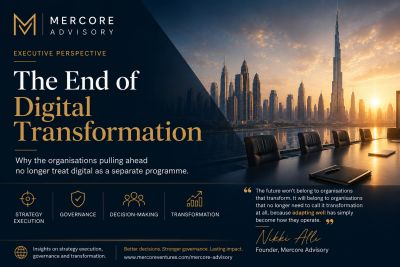
The end of Digital Transformation
Why the organisations pulling ahead no longer treat digital as a separate programme.
For years, organisations have spoken about digital transformation as though it were a destination. They launched transformation programmes, appointed Chief Digital Officers, built digital teams, and invested heavily in technology.
Today, almost every organisation considers itself to be on a digital transformation journey.
Which raises an important question. If everyone is transforming, when does transformation stop?
The reality is that it doesn't. And I don't think that's a failure of execution. I think it's a sign the category itself is disappearing.
I've sat in enough steering committees over the years to watch this shift happen in real time. A few years ago, "digital" sat in its own lane, its own programme, its own budget line, its own committee, often its own leader whose entire mandate was to make the rest of the organisation more digital. Now the same technology conversations, AI, automation, cloud, data, happen inside ordinary strategy and operating discussions, not beside them. Nobody asks for a special governance track to approve a cloud migration anymore. It's just infrastructure. The organisations still running "digital" as a separate initiative are increasingly the exception, not the standard.
Technology is no longer the differentiator. It has become part of how organisations operate every day. Artificial intelligence, automation, cloud platforms and data are no longer specialist initiatives, they're becoming part of mainstream business operations, the way electricity or the internet did before them. Nobody ran an "electrification programme" for very long before electricity simply became infrastructure. Digital is following the same arc, only faster.
That's why I believe we're reaching the end of digital transformation as a separate discipline.
The organisations pulling ahead aren't the ones with the biggest digital programmes. They're the ones making better decisions, adapting faster, and embedding change into the way they run the business as a matter of course, not as a project with a start and end date.
Increasingly, the challenge isn't digital. It's leadership. It's governance. It's deciding where to invest, where to stop, and how to ensure every initiative, digital or otherwise, contributes to strategic value rather than simply consuming budget and attention.
The conversation is shifting from "how do we become digital?" to "how do we become a business that continuously adapts?"
That's a very different question. It doesn't have a project plan or a go-live date. It demands a different kind of leadership — one comfortable with ongoing judgment calls rather than a fixed transformation roadmap, and governance built to support continuous decisions rather than a single programme's milestones.
Perhaps the future won't belong to organisations that transform. It will belong to organisations that no longer need to call it transformation at all, because adapting well has simply become how they operate.
About the Author
Nikki Alli is Founder of Mercore Advisory and an Executive Transformation Leader with over 25 years' experience helping boards and executive leadership teams strengthen strategy execution, governance and AI-enabled business transformation across the Middle East, Africa and Europe.
About Mercore Advisory
Mercore Advisory helps boards and executive leadership teams strengthen strategy execution, decision-making, governance and enterprise transformation.
Mercore Advisory is the executive advisory business of Mercore Ventures.